16.1 Cutover Philosophy
Cutover is not a single event — it is a carefully orchestrated sequence designed for zero-disruption transition with mission control rigor
Mission Control Approach
Rehearsed, monitored, reversible, and supported in real time with the same precision as aerospace operations.
Zero-Disruption Guarantee
Orchestrated sequence moves organizations from old processes to new compliance workflows without operational disruption.
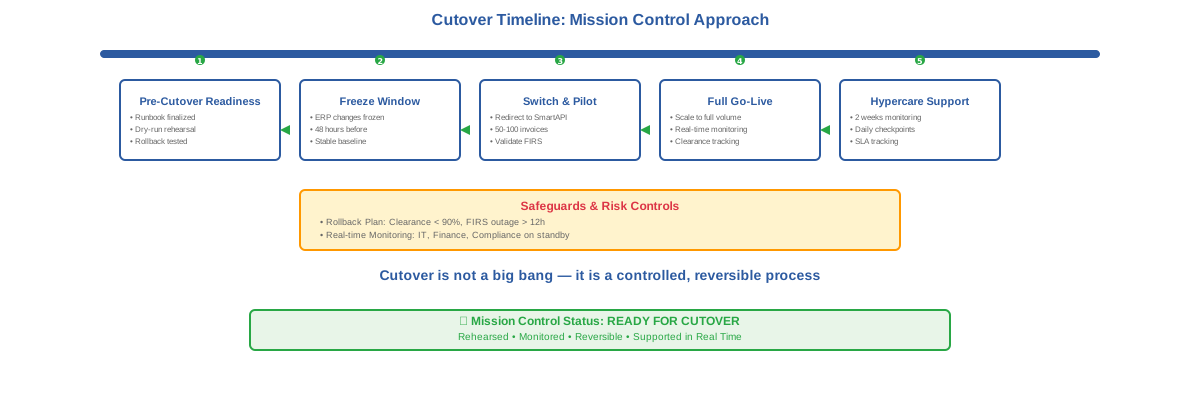
Controlled, reversible process with rehearsed execution and real-time safety nets
16.2 Pre-Cutover Readiness
Comprehensive preparation phase ensuring all prerequisites are met before go-live execution
Cutover Runbook
Prepared with task-by-task activities, owners, and precise timings for every cutover step.
Dry-Run Rehearsal
Conducted in UAT environment, simulating real invoice flow and clearance validation.
Rollback Plan
Defined and tested — ERP can continue using existing invoice processes if critical issues arise.
Approval Gate
Steering Committee reviews readiness checklist and formally authorizes go-live execution.
16.3 Cutover Execution Steps
Seven-step execution sequence with validation checkpoints and real-time monitoring
Freeze Window
ERP integration changes frozen 48 hours before go-live to establish stable baseline.
Final Data Validation
Confirm master data (TINs, HS codes, tax codes) loaded and reconciled before switch.
Switch Integration
Reroute ERP outputs to SmartAPI production tenant with immediate connectivity validation.
Pilot Batch
Submit first set of live invoices (typically 50–100), validate clearance with FIRS.
Validation
Confirm IRNs and QRs received, archive entries created, Finance reconciliation matches.
Scale-Up
Expand to full invoice volume with continuous throughput and clearance monitoring.
Monitoring
Real-time dashboards active with IT and Finance on standby during first 48 hours of production operations.
16.4 Hypercare Support & Rollback Plan
24x7 intensive support with automated rollback triggers ensuring operational continuity
Hypercare Duration
Coverage: Two weeks post go-live (extendable by client request)
Support: 24x7 incident response, daily checkpoint calls with Finance, IT, and Compliance
Focus: Clearance rate monitoring, rejection handling, reconciliation, and system performance
Rollback Plan
Triggers: Clearance rates drop below threshold, critical ERP disruption, FIRS outage > 12 hours
Actions: ERP outputs redirected to legacy processes, SmartAPI queues paused (no data loss), pending invoices replayed
16.6 Transition to Steady State & Benefits
Seamless handover with continuous improvement and executive confidence
Knowledge Transfer
Runbooks, playbooks, and dashboards handed over to client IT and Finance teams.
Governance Setup
Quarterly service review cadence initiated for ongoing performance management.
Continuous Improvement
Improvement backlog from hypercare fed into product roadmap for enhancements.
Benefits of Our Approach
No Surprises
Rehearsals eliminate uncertainty with comprehensive dry-run validation and risk mitigation.
No Downtime
Rollback safety net protects Finance operations with seamless fallback mechanisms.
No Invoice Loss
SmartAPI queues guarantee delivery once FIRS resumes with zero data loss assurance.
Executive Confidence
CFOs and CIOs can sign off knowing every risk has been identified and mitigated.